
For generations, coal- and gas-fired forges have been an integral part of the work of blacksmiths and forging professionals. Today, induction forging offers a different approach to metal heating, with fast, precise, and easily controlled heating.
But what are the actual differences between these technologies? Heating time, energy consumption, precision, working conditions, and flexibility are all criteria that can be considered when determining the solution best suited to a forging application.
Key Takeaways
The choice between induction, coal, and gas depends on the workshop’s needs and the characteristics of the parts to be heated.
- Heating time: induction provides rapid heating, with no preparation time associated with combustion.
- Precision and flexibility: it makes it possible to target the heating zone and adapt heating to different applications.
- Energy and constraints: unlike coal and gas, induction requires neither combustion nor fuel storage.
- Choice of technology: this depends on the type of part, production rate, and constraints specific to each application.
Induction vs. Coal: A Significant Difference in Heating Time
With a traditional coal forge, part of the working time is spent lighting the fire, bringing the hearth up to temperature, and maintaining it.
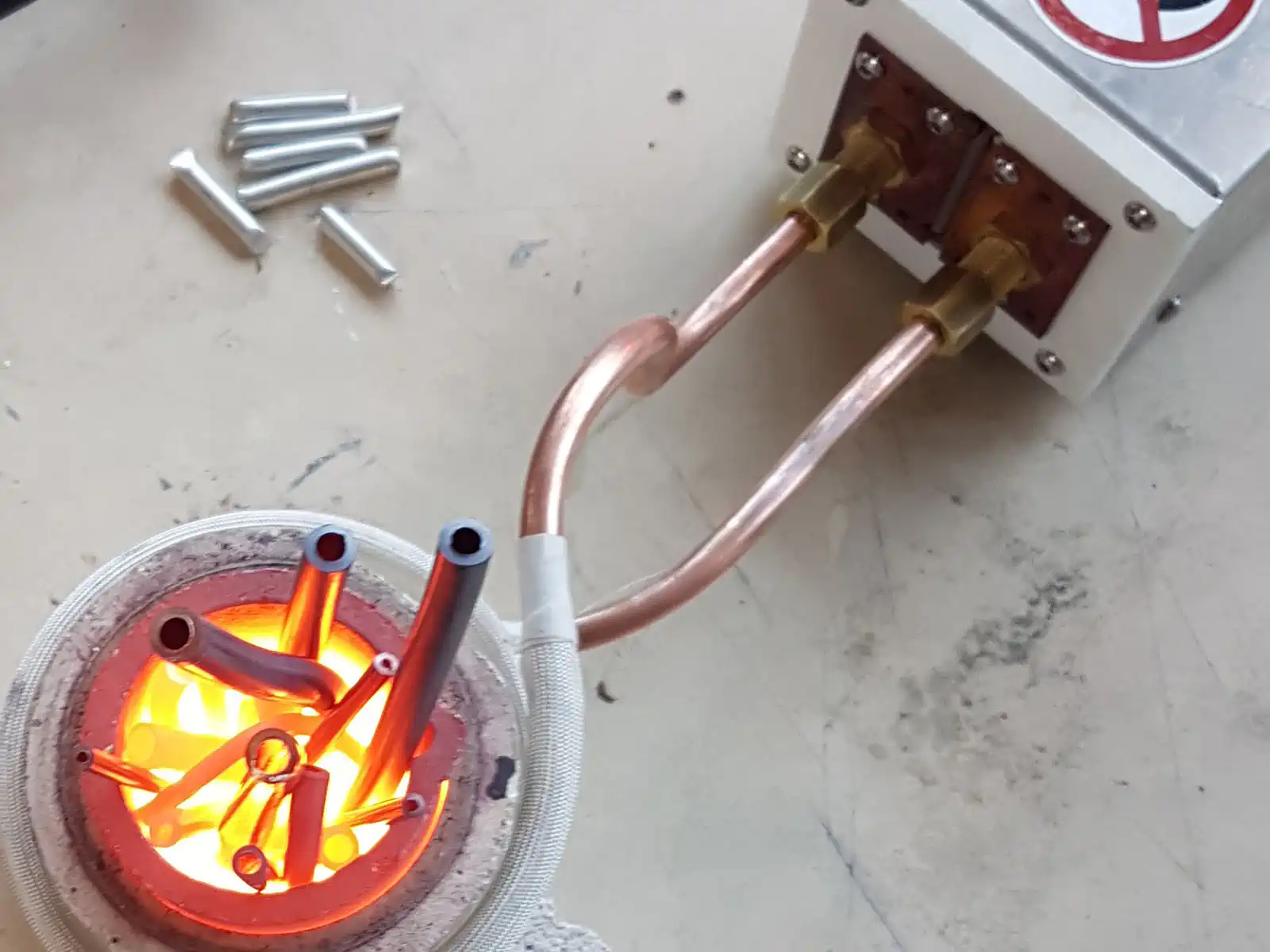
With an induction forge, heating starts as soon as the workpiece is positioned in the inductor. Energy is then generated directly within the metal, without having to heat a hearth beforehand.
In some applications, a workpiece that previously required several tens of minutes of preparation can therefore reach temperature in just a few minutes.
Heating time can thus become a genuine productivity lever, particularly for professionals who regularly carry out forging operations.
As Pierre Reverdy, Master of Art and Master Cutler, and user of a 24 kW forge, puts it: “It’s the hours that count. And the hours that cost.”
For a craftsperson or company using its forge on a daily basis, reducing the time spent on preparation and heating can therefore have a significant impact on workflow.
Induction Forging: Controlling Energy Consumption
The cost of energy is also an important factor when choosing a heating technology.
A coal forge requires fuel to be stored and regularly replenished. Its consumption depends in particular on the type of work being carried out, the efficiency of the hearth, and the duration of use.
A gas forge also requires a fuel supply, with consumption varying according to the power used and operating time.
With an induction forge, energy is used directly to heat the workpiece. Heating can be started when needed and stopped as soon as the operation is complete.
However, an economic comparison should be based on the actual use of the equipment: heating time, number of parts, production rate, frequency of use, and local energy costs.
Depending on the configuration, productivity gains and better control of energy consumption can help reduce operating costs and accelerate the return on investment.
A Cleaner Workshop with Induction
Coal forging generates smoke, dust, and residues associated with combustion. It also requires fuel storage and suitable ventilation.
Gas forging also relies on combustion and requires appropriate management of the installation and the evacuation of combustion products.
Induction heating, on the other hand, operates without combustion at the workpiece and without a direct flame. It can therefore help limit emissions associated with the combustion of coal or gas in the heating area.
This can be an advantage for workshops looking to improve working conditions and reduce the constraints associated with fuel storage and combustion.
Fewer Constraints, More Flexibility
A traditional forge requires fuel, hearth management, and temperature control during the heat-up phase.
With induction, there is no longer any need to store coal or manage a gas supply to carry out heating. The equipment can also be designed in a compact format and adapted to different workstations.
This flexibility can be particularly useful for professionals working with individual parts or small production runs.
Depending on the model and application, an induction heating solution can also be integrated into an existing machine or used directly on certain job sites.
Induction Forge or Coal and Gas Forge?
Each technology has its own characteristics and can meet different needs depending on the application.e à des besoins différents.
| Criteria | Induction Forge | Coal Forge | Gas Forge |
| Heating time | Fast | Longer | Intermediate |
| Heating precision | Highly precise | Less localized | Good |
| Fuel storage required | No | Yes | Yes |
| Combustion fumes | No | Yes | Yes |
| Localized heating | Yes | Limited | Possible |
| Mobility | High, depending on model | More restrictive | Variable |
| Automation | Easy to integrate | Limited | Possible |
The choice therefore depends primarily on the application, the type of parts being worked, the production volume, and the constraints of the workshop.
Why Choose Induction for Your Forge?
Switching to an induction forge is not simply a matter of replacing one heat source with another. This technology also changes how heating can be integrated into the forging process.
It can, in particular, make it possible to:
- Reduce the time spent heating;
- Heat a specific area precisely;
- Gain greater control over heating cycles;
- Eliminate the need to store fuel;
- Work without combustion at the workpiece;
- Use compact equipment;
- Process individual parts or small production runs;
- Integrate heating into an existing machine.
These characteristics can be particularly valuable for craftspeople and professionals looking to improve their workstation and optimize their forging operations.

