
Choosing an induction forge depends on several criteria: the type of workpiece to be heated, its material, dimensions, the desired heating zone, and the production volume. Whether for an individual part or a small production run, induction provides precise, localized, and controlled heating.
To choose the right equipment, it is therefore essential to understand the main parameters that influence induction heating.
Key Takeaways
Choosing an induction forge depends primarily on the characteristics of the workpiece and production requirements.
- The workpiece and material: consider its dimensions, geometry, and the material to be heated.
- The heating zone: determine whether heating needs to be applied to the entire workpiece or only to a specific area.
- Power and frequency: adapt them to the desired heating time and heating depth.
- The inductor: choose a geometry suited to the workpiece to ensure precise and controlled heating.
How Do You Choose an Induction Forge?
Choosing an induction forge depends on several criteria: the type of workpiece to be heated, its material, dimensions, the desired heating zone, and the production volume. Whether for an individual part or a small production run, induction provides precise, localized, and controlled heating.
To choose suitable equipment, it is therefore essential to understand the main parameters that influence induction heating.
Why Choose an Induction Forge?
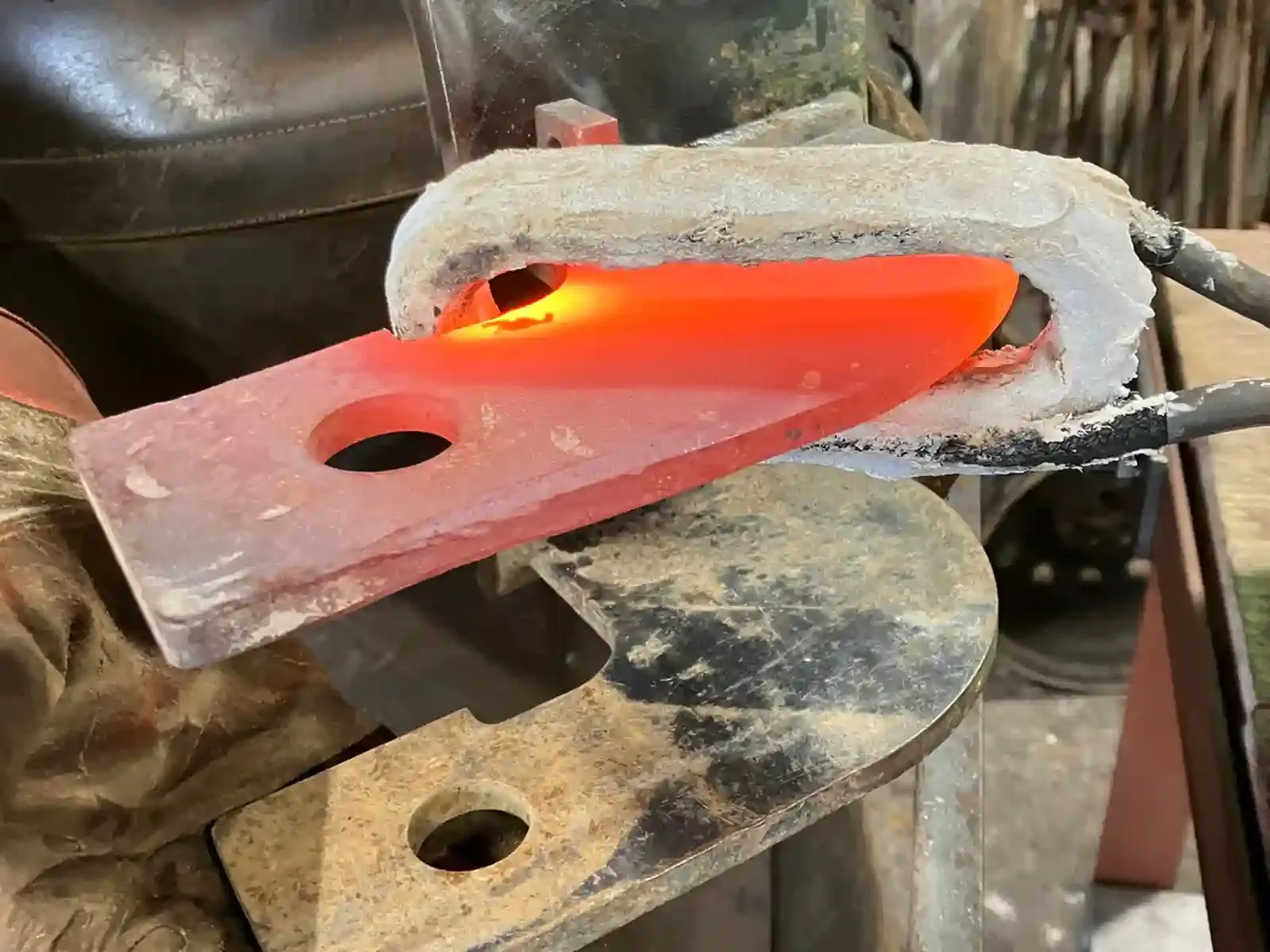
An induction forge heats the workpiece directly using an electromagnetic field. This technology provides fast, localized heating, which is particularly useful when only part of the workpiece needs to reach forging temperature.
Unlike traditional heating methods, induction makes it possible to concentrate energy on the desired area and achieve greater control over the heating cycle.
It can be adapted to a range of needs, including:
- Precise, localized heating to control the area being treated;
- Individual workpiece heating for specific or occasional requirements;
- Small production runs with repeatable heating;
- A compact format that facilitates integration into a workshop;
- Adaptation to existing machines or direct use on job sites.
These characteristics make induction forging an interesting solution for applications requiring precision, flexibility, and heating control.
How Do You Choose an Induction Forge?
Equipment should be selected according to the application and the characteristics of the workpiece to be heated.
Several parameters must be considered, including power, frequency, and inductor design.
Power
The generator power must be suited to the material, dimensions of the workpiece, target temperature, and desired heating time.
A small workpiece will not require the same energy input as a larger, heavier part. Similarly, the time available to reach forging temperature can influence the sizing of the equipment.
Power should therefore be selected according to the actual heating requirements in order to achieve a heating time suited to the application.
Frequency
Frequency plays an important role in determining the depth of heat penetration.
It must be selected according to the material, workpiece geometry, and area to be heated. In general, a higher frequency promotes more concentrated surface heating, while a lower frequency allows greater penetration of energy into the material.
It is therefore essential to consider power and frequency together when choosing an induction forge. Both parameters must be adapted to the characteristics of the workpiece and the desired result.
The Inductor
The inductor is at the heart of the induction heating process. It generates the electromagnetic field and concentrates energy on the desired area.
Its design must take into account the shape, dimensions, and geometry of the workpiece. A properly designed inductor makes it possible to achieve more targeted heating that is consistent with the application.
For specific workpieces or heating operations, inductor design is therefore an important factor when choosing an induction forge.
A Compact and Adaptable Solution
Another advantage of induction forging is the ability to use compact equipment that can be adapted to different working environments.
A compact system can be integrated into an existing machine or adapted to a production workstation. For on-site operations, a mobile solution can also bring the heating equipment directly to the workpiece.
This flexibility is particularly useful for companies working with individual parts or small production runs, where a large, fixed installation is not always necessary.
Which Induction Forge Is Right for Your Application?
Le choix de la forge à induction dépend donc principalement du type d’application et du niveau de flexibilité recherché.
| Your Requirement | Recommended Solution |
| Individual part | Flexible and easily adjustable forge |
| Small production run | Repeatable and controlled heating |
| Localized heating | Inductor adapted to the workpiece |
| Machine integration | Compact and adaptable generator |
| On-site work | Mobile solution |
| Industrial application | Automatable system |
There is therefore no single configuration suited to every situation. Power sizing, frequency selection, and inductor design must be determined according to the workpiece and the forging process.

