

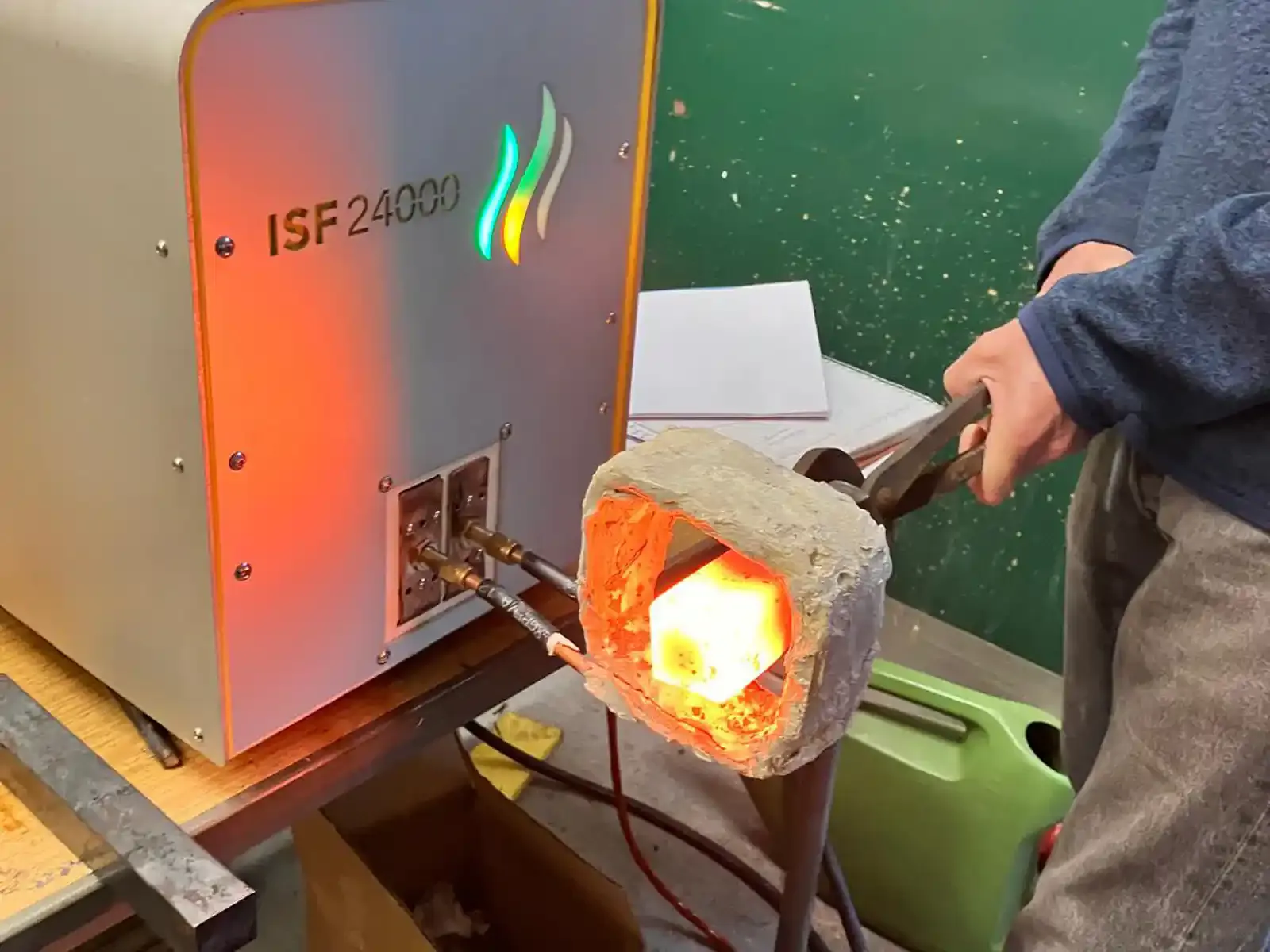
Induction heating is a technology particularly well suited to forging operations requiring speed, precision, and precise temperature control. But how does this technology work, and what are its main advantages for forging?
Key Takeaways
Induction heating is based on an electromagnetic principle that makes it possible to heat metal parts quickly and precisely.
- The principle: an electromagnetic field generates eddy currents in the workpiece, which are converted into heat through the Joule effect.
- Power and frequency: these parameters make it possible to adjust the intensity and depth of the heating.
- The inductor: its shape and positioning determine the heating zone.
- The advantages: fast, precise, and repeatable heating, suitable for a wide range of forging operations.
How Does Induction Heating Work?
Induction heating is based on an electromagnetic principle.
A generator supplies an electrical current to an inductor, generally consisting of a copper coil. The inductor creates an alternating magnetic field around the metal workpiece.
This magnetic field generates eddy currents directly within the metal. The electrical resistance of the material converts this energy into heat through the Joule effect.
The workpiece is therefore heated without direct contact and without a flame. Energy is generated directly within the material, making it possible to concentrate the heat on the desired area.
The Role of the Inductor
The inductor plays a key role in induction heating for forging. Its shape, dimensions, and positioning determine the distribution of the electromagnetic field and, consequently, the area being heated.
Depending on the application, it is possible to achieve:
- Heating of the entire workpiece;
- Localized heating of part of the workpiece;
- Heating adapted to the geometry of the workpiece.
This level of precision is particularly useful for forging operations that require only part of a workpiece to be heated.
The inductor must therefore be designed to match the characteristics of the workpiece and the desired result. It is an important element when sizing an induction heating system.
Why Is Frequency Important?
The induction frequency affects the depth at which heating is concentrated within the metal.
The choice of frequency depends in particular on:
- The material;
- The dimensions of the workpiece;
- Its geometry;
- The area to be heated;
- The desired temperature;
- The required heating time.
In general, a higher frequency promotes more concentrated heating near the surface, while a lower frequency allows the energy to penetrate further into the material.
The choice of frequency must therefore be considered together with the generator power and inductor design to achieve heating suited to the forging operation.
The Advantages of Induction Heating for Forging
Induction technology offers several advantages for forging operations:
- Fast heating;
- Precise, localized heating;
- Controlled temperature;
- Good repeatability of heating cycles;
- Suitable for individual parts and small production runs;
- Compact equipment that is easy to integrate.
Induction heating also makes it possible to limit heating to the areas where it is needed. This can be particularly useful when the forging operation does not require the entire workpiece to be brought to temperature.
Depending on the requirements, the system can be integrated into an existing machine, a production workstation, or configured as a mobile solution for certain applications carried out directly on site.
What Parameters Should Be Considered for Induction Heating?
To achieve effective heating, several parameters must be considered together.
The material, dimensions, and mass of the workpiece determine the energy requirements. The desired forging temperature and the available time to reach it also influence the sizing of the generator.
Power, frequency, and the inductor must therefore be selected consistently with the application.
Proper sizing makes it possible to concentrate energy effectively on the desired area and achieve sufficiently uniform heating for the forging operation.
A Technology Suitable for Different Forging Applications
Thanks to its precision and flexibility, induction heating can be used in a wide range of configurations.
It is particularly suitable for individual parts, small production runs, localized heating operations, and applications requiring integration into a machine.
The choice of system therefore depends primarily on the workpiece to be heated, the area concerned, and the characteristics of the forging process.

